KALKI 2.0
A local-first AI assistant for the Windows desktop
- Year
- 2025–2026
- Category
- AI & Software
- Status
- Published on the Microsoft Store (v1.0.4) · Open source
01 — Summary
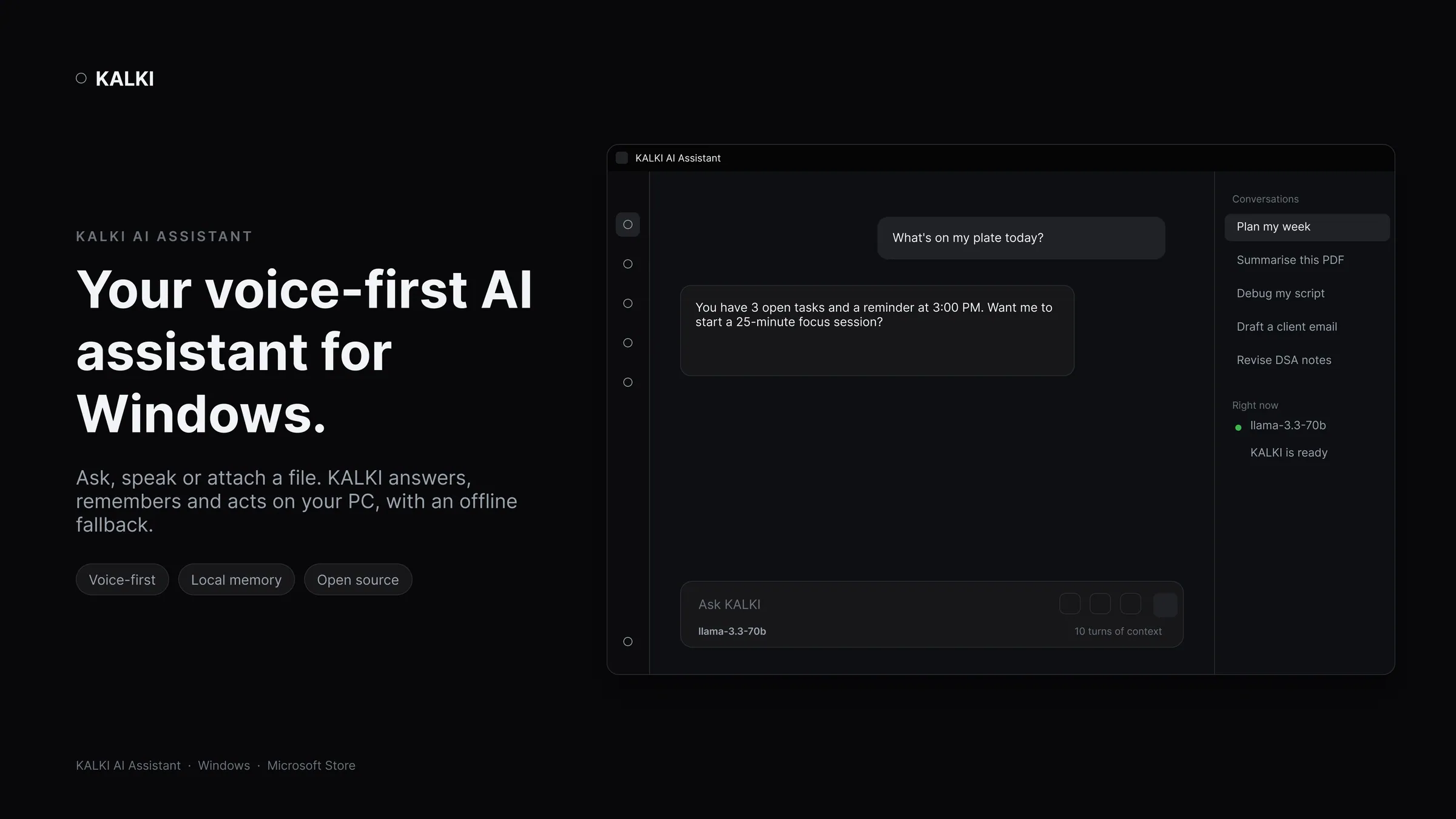
A desktop assistant that combines offline voice input, switchable local and cloud language models, local memory and guarded system actions in one HUD workspace.
02 — The challenge
Desktop AI assistants usually force a compromise: closed, cloud-tethered products that send your context to remote servers, or developer scripts with no real interface, voice input or safety model.
Giving an assistant access to the operating system is risky unless every action is explicitly gated. Cloud models add latency; purely offline models struggle with complex reasoning.
03 — Our approach
We built KALKI around two brains. Private and offline queries go to a local Ollama model running entirely on the machine. Heavier reasoning can be routed to cloud providers such as Groq, OpenAI or Gemini.
Credentials are encrypted with Windows DPAPI, so no secrets are stored in plain text. Every system action (file changes, network diagnostics, process management) shows a dry-run diff and waits for the user to confirm.
Built for: Engineers, researchers and privacy-conscious professionals who want fast desktop AI without handing their context to a closed cloud product.
04 — How it works
- 01
Secure start-up
On launch, the runtime decrypts provider keys from the DPAPI vault and checks the local Ollama connection.
- 02
Voice or text
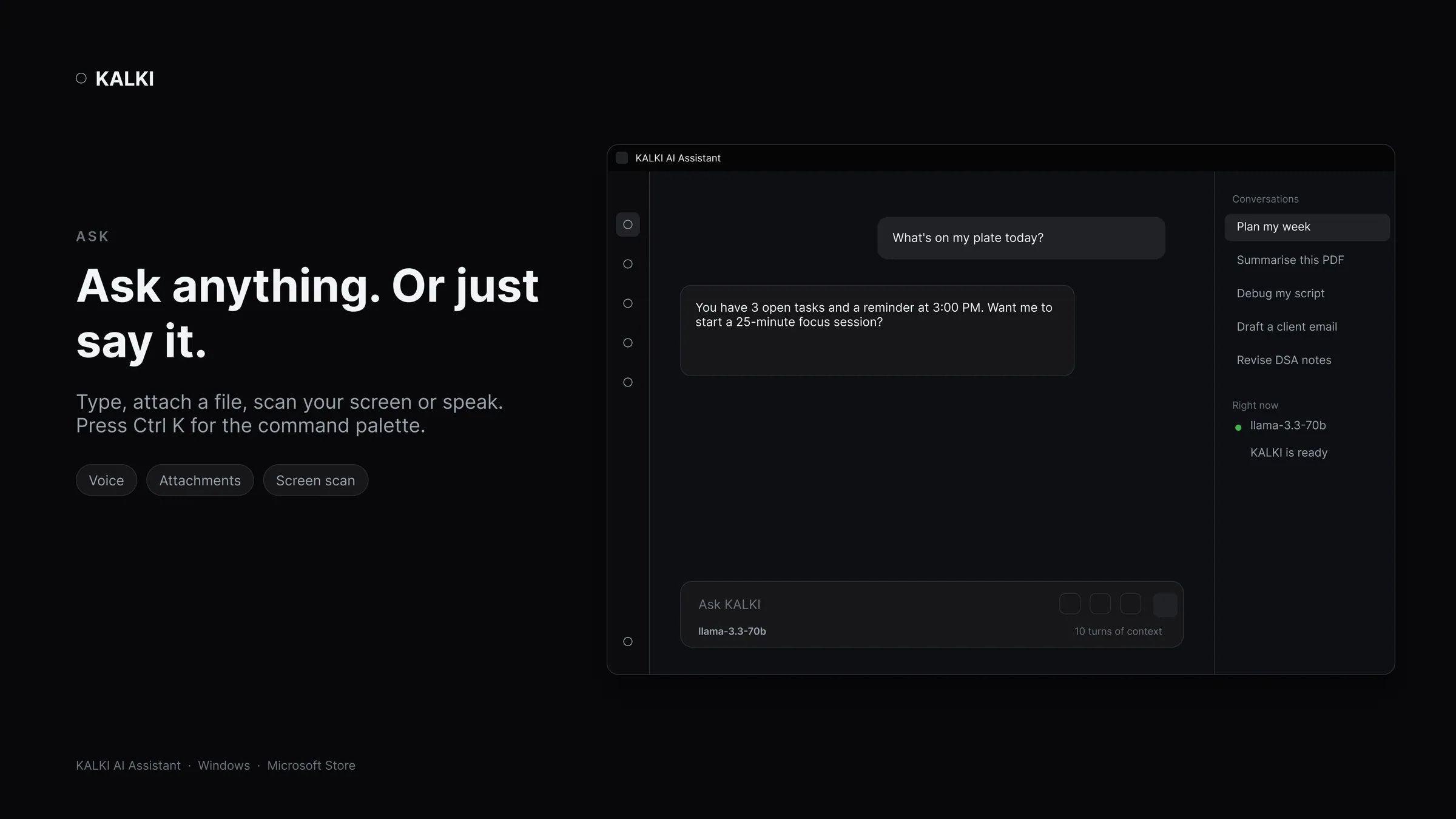
A global hotkey or offline VOSK voice detection starts an interaction, with no network needed for speech.
- 03
Route and recall
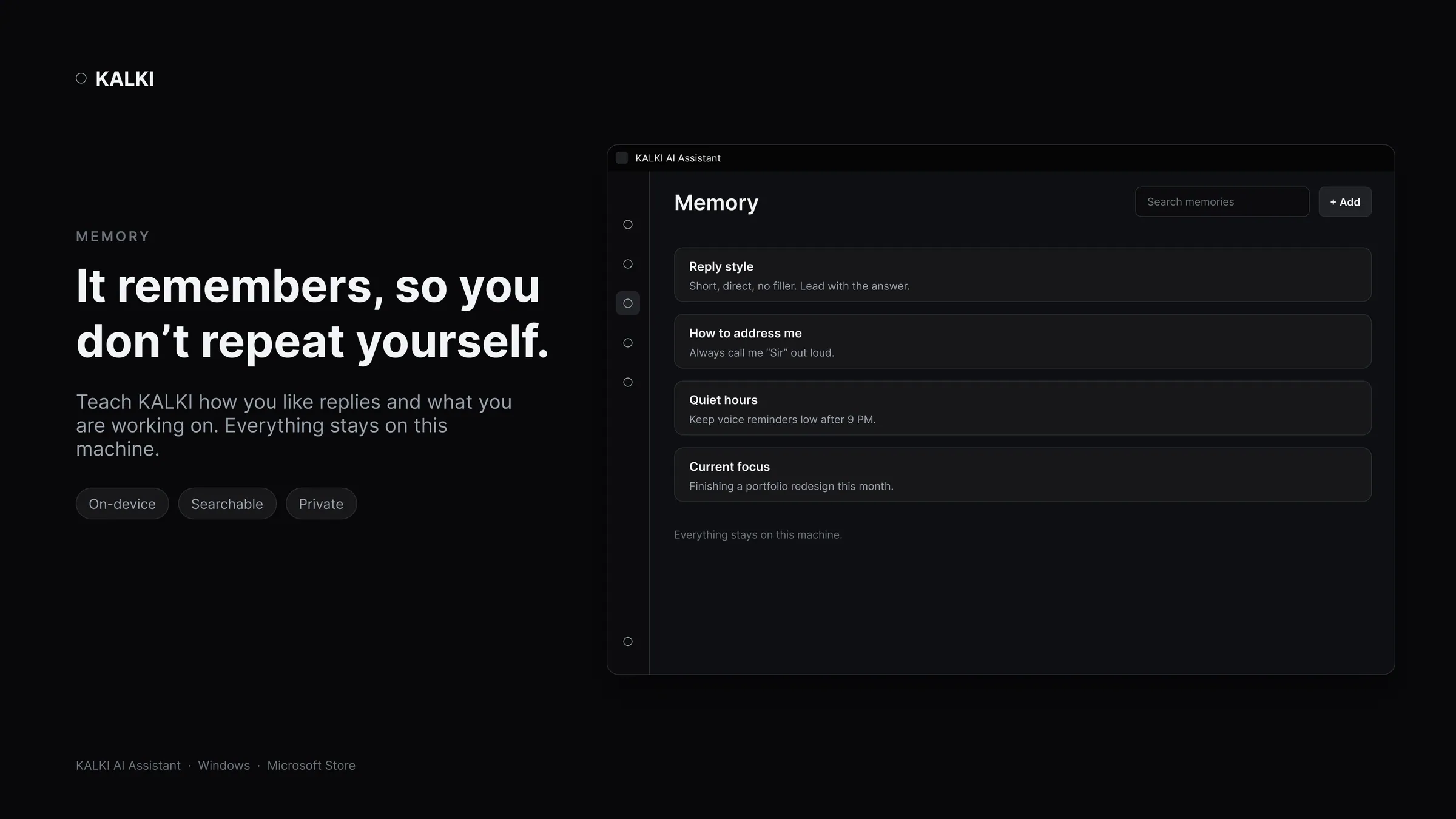
The assistant checks local memory for context, then decides whether to answer locally or with a cloud model.
- 04
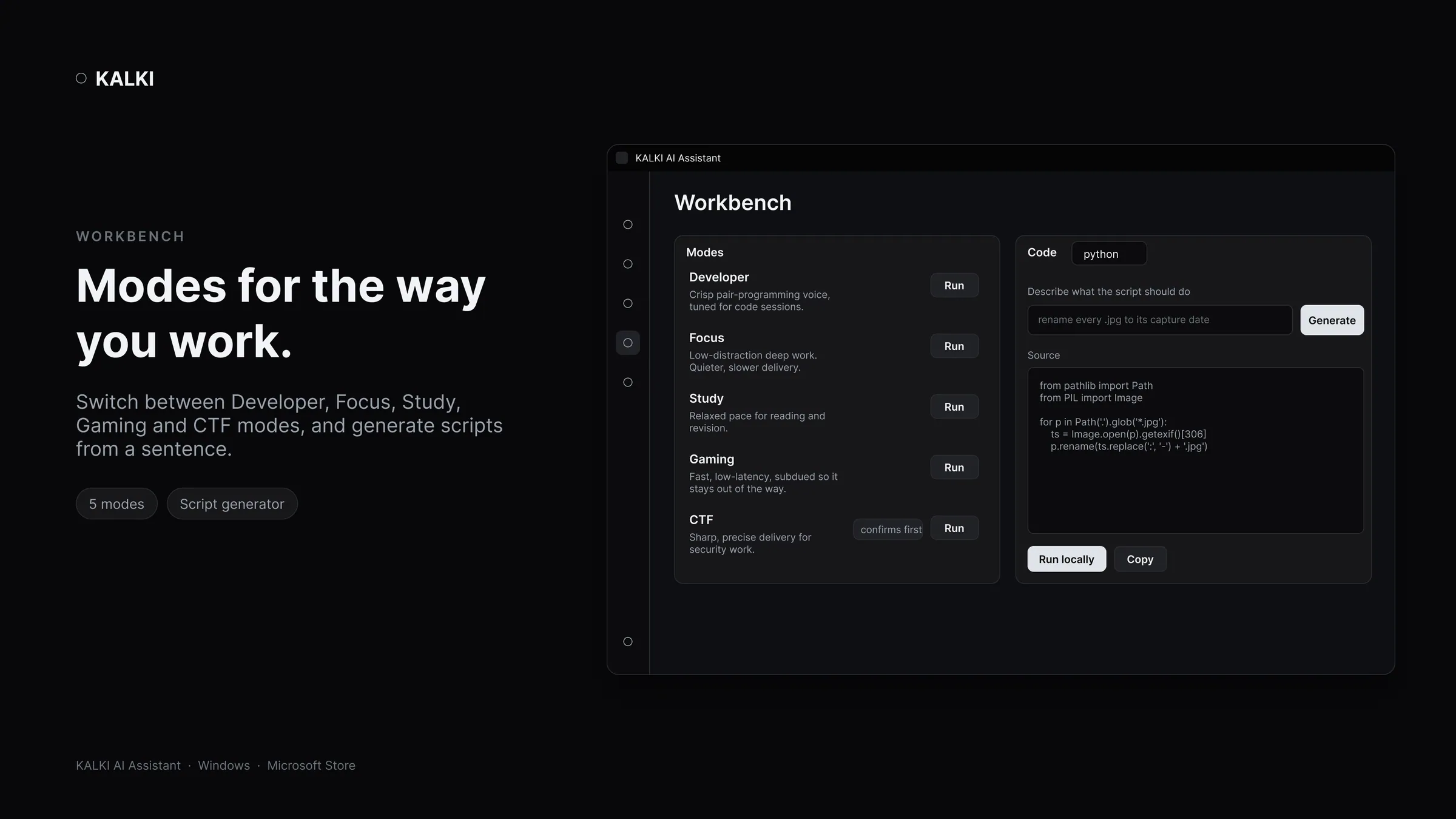
Guarded actions
Any system action is shown as a dry run and only runs after explicit confirmation.
- 05
Stream and remember
Responses stream into the HUD while summaries are indexed into local storage for later recall.
05 — Build notes
- An authenticated IPC bridge between the HUD and the background runtime.
- Offline speech recognition with lightweight VOSK models and no external connections.
- A built-in toolkit for IP lookups, port scans, DNS checks and password strength.
- CI producing MSIX packages for the Microsoft Store and GitHub releases.
Stack
- Python
- Ollama
- Groq
- Windows DPAPI
- VOSK
- Windows App SDK
- Store version
- v1.0.4
- Package ID
- 9P6HJPQZBGFQ
- Licence
- MIT
06 — Why it matters
It shows that local-first, private AI can still feel polished and still reach cloud-scale reasoning when the user chooses it.
Next case study
Ztees